Resources

Resources to help prepare you and keep you on track
We’re here to support you on your journey with polycythemia vera (PV) and BESREMi. Explore our downloadable guides and educational tools below to help you feel more confident and informed every step of the way.

Your Guide to BESREMi
Want to understand how BESREMi helps you take control of PV? Our brochure breaks down the basics, helping you and your loved ones learn about this path forward together.

What to Expect Guide
Find practical tips for getting started with BESREMi, including how to manage any potential side effects and when you can expect to start seeing results.

Doctor Discussion Guide
Are you ready to talk to your doctor about BESREMi? This guide offers helpful questions and topics to empower and prepare you for those conversations.
Instructions for Use
Our easy-to-follow, step-by-step instructions on how to give yourself an injection with the BESREMi prefilled syringe will help guide you through the process.
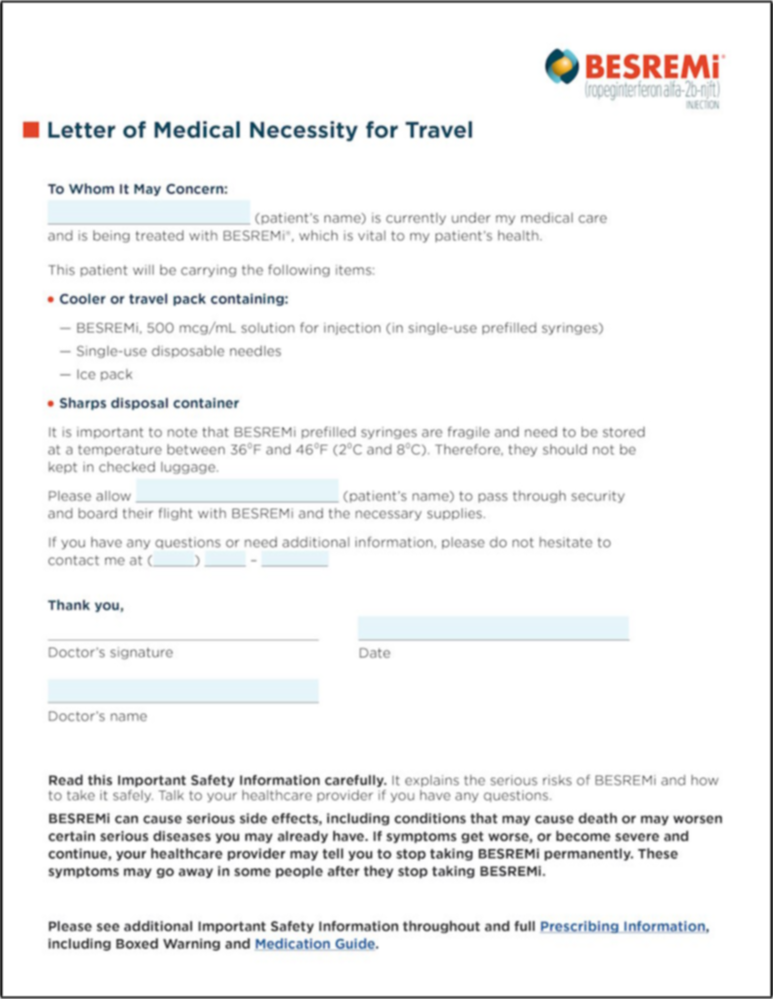
Travel Letter
If you’re flying with BESREMi, this letter can help you explain your medication needs to airport security to ensure smoother travel.
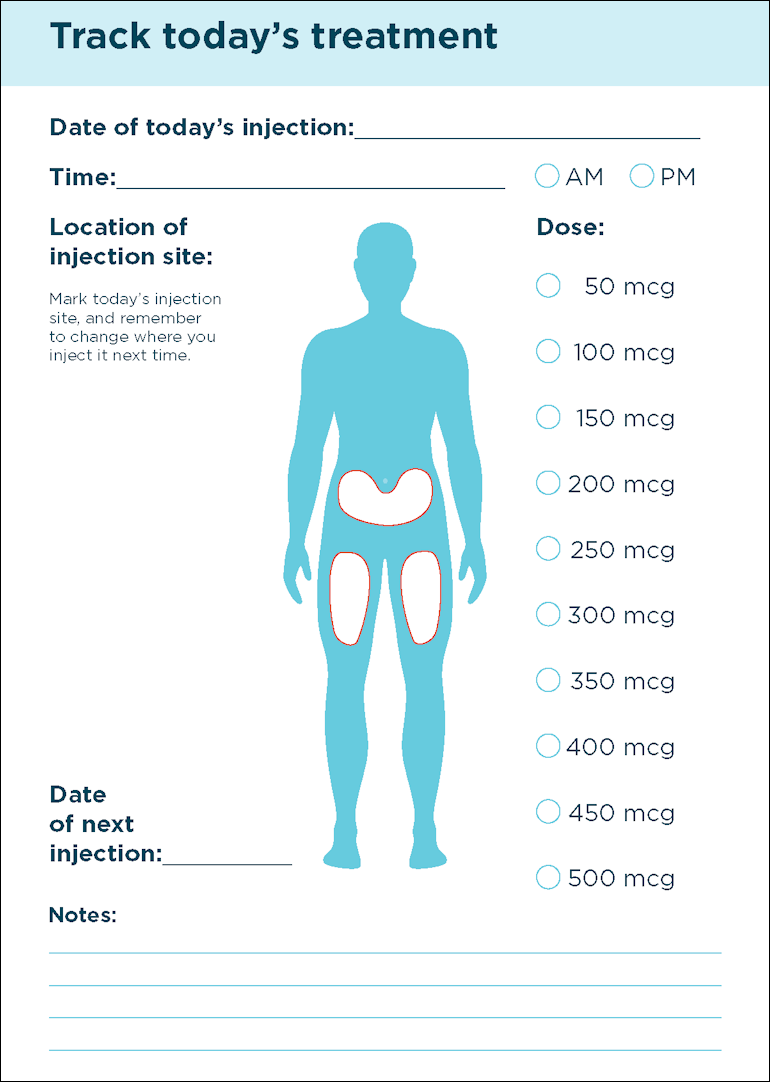
Treatment Tracker Sheets
Ran out of pages in the treatment tracker notepad from your Welcome Kit? Print more sheets to detail each treatment.
Glossary of PV terms
Get to know some key words you may hear or see when learning about PV and BESREMi.
Blood cells
Types of cells that support various functions in the body. Created in the bone marrow, they begin as stem cells and mature into red blood cells, white blood cells, and platelets.
Bone marrow
The soft, spongy tissue inside bones that makes blood cells.
Cardiovascular events
Incidents that can damage the heart and blood vessels, such as a heart attack or stroke.
Chemotherapy
A treatment that uses drugs to kill cancer cells or slow their growth.
Complete hematologic response (CHR)
When all blood cell counts have returned to normal levels, typically after treatment for a blood-related condition.
Comprehensive disease control (CDC)
When all blood cell counts and spleen size have returned to normal and there is an absence of thromboembolic events, typically after treatment for a blood-related condition.
Efficacy
The ability of a treatment to produce the desired result.
Hematocrit (HCT)
The percentage of red blood cells in your blood.
Hydroxyurea (HU)
A type of chemotherapy that reduces the production of abnormal blood cells and lowers the risk of blood clots.
Immunotherapy
A treatment that uses certain parts of the body’s immune system to fight disease.
Interferon
A protein that helps control cell growth and regulate the immune system.
JAK2
A gene that helps make a protein that controls cell growth, especially blood cells.
JAK2 mutation
A change in the JAK2 gene that can lead to blood disorders where the blood makes too many blood cells.
Leukemia
A type of cancer that starts in the blood or bone marrow and causes the body to rapidly produce abnormal white blood cells.
Myelofibrosis (MF)
A rare type of cancer that starts in the bone marrow, leading to scarring and making it harder to produce blood cells.
Myeloproliferative neoplasms (MPNs)
Blood cancers in which the bone marrow makes too many blood cells.
Phlebotomy (PHL)
A procedure of drawing blood to reduce excess blood cells and decrease blood volume.
Platelets
Small cell fragments that help form clots and stop bleeding.
Red blood cells (RBC)
A common type of blood cell that delivers oxygen to the rest of the body.
Stem cells
Cells in the body that can develop into different types of cells.
Thrombotic events
Situations where blood clots form in a blood vessel or the heart, which can block blood flow.
Thromboembolic events
Situations where a blood clot breaks loose and travels to another part of the body, causing a blockage.
White blood cells (WBC)
A type of blood cell that helps the body fight infections and disease.
Find financial support
PharmaEssentia SOURCE provides personalized support to help you with starting and staying on BESREMi, including finding resources for financial support.
Advocacy groups to aid your journey
You’re not alone. If you’re living with PV, there are a variety of advocacy groups dedicated to supporting you and your loved ones. Select a group below to learn more.

Advocacy groups to aid your journey
You’re not alone. If you’re living with PV, there are a variety of advocacy groups dedicated to supporting you and your loved ones. Select a group below to learn more.
Please note: PharmaEssentia is not responsible for the content or availability of linked websites. The information provided by PharmaEssentia is for informational purposes only and is not meant to replace the advice of a healthcare professional.
IMPORTANT SAFETY INFORMATION
Reference: 1. Referenced with permission from the NCCN Clinical Practice Guidelines in Oncology (NCCN Guidelines®) for Myeloproliferative Neoplasms V.1.2025. © National Comprehensive Cancer Network, Inc. 2025. All rights reserved. Accessed February 25, 2025. To view the most recent and complete version of the guidelines, go online to NCCN.org. NCCN makes no warranties of any kind whatsoever regarding their content, use or application and disclaims any responsibility for their application or use in any way.
Read this Important Safety Information carefully. It explains the serious risks of BESREMi and how to take it safely. Talk to your healthcare provider if you have any questions.
What is the most important information I should know about BESREMi?
BESREMi can cause serious side effects, including conditions that may cause death or may worsen certain serious diseases you may already have. If symptoms get worse, or become severe and continue, your healthcare provider may tell you to stop taking BESREMi permanently. These symptoms may go away in some people after they stop taking BESREMi.
Mental health problems, including suicide
BESREMi may cause mood or behavior problems that can get worse during treatment or after your last dose, including:
- Irritability (getting upset easily)
- Restlessness and agitation
- Confusion
- Depression (feeling low, hopeless, or bad about yourself)
- Unusually grand ideas
- Acting aggressive or impulsively
- Thoughts of hurting yourself or others, or thoughts of suicide
If you develop any of these symptoms, call your healthcare provider immediately.
New or worsening autoimmune problems
BESREMi may cause your immune system to attack healthy cells, leading to conditions such as thyroid disease, increased blood sugar (hyperglycemia), or type 1 diabetes. Call your healthcare provider if you experience:
- Extreme tiredness
- Frequent urination
- Excessive thirst
Heart problems
BESREMi may cause heart problems, including:
- Cardiomyopathy (heart muscle disease)
- Heart attack
- Irregular heartbeat (atrial fibrillation)
- Decreased blood flow to the heart
You should not take BESREMi if you have:
- Uncontrolled high blood pressure
- Congestive heart failure
- A serious abnormal heart rhythm
- Narrowing of the arteries to your heart
- Certain types of chest pain (angina)
- A recent stroke or heart attack
Who should not take BESREMi?
Do not take BESREMi if you:
- Have or had severe mental health problems, especially depression, suicidal thoughts, or attempted suicide
- Have or had a serious or untreated autoimmune disease
- Are allergic to interferon or any ingredient in BESREMi (symptoms may include itching, swelling, trouble breathing, dizziness, or chest pain)
- Have certain types of liver disease
- Have had a transplant and take immune-suppressing medication
Before using BESREMi, tell your healthcare provider about all of your medical conditions, including if you have any of the following:
Do not take BESREMi if you:
- A mental illness
- Type 1 diabetes
- Heart or bleeding problems
- Problems with your immune system
- Hepatitis B or HIV infection
- Kidney or liver problems
- Are pregnant or planning to become pregnant
- BESREMi may harm your unborn baby. Use effective birth control during treatment and for at least 8 weeks after your last dose
- BESREMi may affect your menstrual cycle and could stop your periods
- Do not breastfeed while taking BESREMi
What are the possible side effects of BESREMi? Serious side effects include:
- Low blood cell counts: taking BESREMi can lead to infections, anemia, or bleeding problems. Call your healthcare provider right away if you develop weakness and tiredness, bruising easily, nose bleeds often, fever, chills, burning and painful urination, urinating often, or coughing up yellow or pink mucus (phlegm)
- Serious allergic reactions: Get medical help right away if you get any of the following symptoms: skin rash or hives; itching; swelling of the face, eyes, lips, tongue, or throat; trouble breathing; chest pain; or feeling faint
- Eye problems: BESREMi can cause severe eye problems with your retinas that can lead to vision loss or blindness. You should have an eye exam before and during treatment with BESREMi if you have diabetes or high blood pressure and also have retinal problems
- Liver problems: BESREMi can cause increases in liver enzymes and liver damage. Your healthcare provider should do blood tests to monitor your liver enzymes and liver function before you start and during treatment with BESREMi
- Kidney problems: Your healthcare provider will do blood tests to check your kidney function before starting and during treatment with BESREMi. Tell your healthcare provider right away if you develop any symptoms of a kidney problem, including: changes in the amount or color of your urine, swelling in your ankles, blood in your urine, or loss of appetite
- Tooth and gum problems: BESREMi can cause tooth loss and/or dry mouth. It is important for you to brush your teeth well, two times each day and have regular dental examinations during treatment with BESREMi
- Skin reactions: BESREMi may cause reaction such as rash, itching, and hair loss
- Increased triglycerides: You may require blood tests to monitor levels
The most common side effects of BESREMi include:
- Flu-like symptoms, including tiredness, weakness, fever, chills, muscle aches, and joint pain
- Itching
- Sore throat
These are not all of the possible side effects of BESREMi.
Call your doctor for medical advice about side effects. You may report side effects to PharmaEssentia at 1-800-999-2449 or FDA at 1-800-FDA-1088.
Please see full Prescribing Information, including Boxed Warning and Medication Guide for BESREMi.